North-West University (NWU) has re-joined the Inter-University Institute for Data Intensive Astronomy (IDIA), strengthening South Africa’s radio astronomy capacity in preparation for the SKA Observatory (SKAO). Membership gives NWU researchers and students partner access to IDIA’s ilifu research cloud and software support expertise, maximising their scientific return from the MeerKAT radio telescope and their readiness for the SKAO. In turn, NWU brings world-class multimessenger expertise to the university partnership, including high-energy astrophysics with the future Cherenkov Telescope Array Observatory (CTAO). It also expands IDIA’s geographic footprint and extends its support for radio transient science and future SKA-Low users in South Africa and across the continent.
As a founding partner of IDIA, NWU now rejoins the Institute alongside the University of Cape Town (UCT), the University of the Western Cape (UWC), the University of Pretoria (UP), and in close collaboration with the South African Radio Astronomy Observatory (SARAO). NWU’s return reinforces the collaborative foundation on which this university partnership was established and is a testament to what IDIA has achieved over the past decade. The NWU Centre for Space Research (CSR) has a long history in multimessenger astronomy, as well as heliospheric and ionospheric physics, all of which contribute to broadening the scientific capabilities within IDIA’s partnership.
“MeerKAT produces some of the most demanding datasets in astronomy, while MeerKAT+ and the SKAO will raise that bar further still. IDIA exists so that South Africa leads the science from these telescopes, rather than just hosting them. NWU’s return strengthens that mission and broadens our community of researchers and students preparing for the SKAO era.” – Prof Roger Deane, IDIA Director
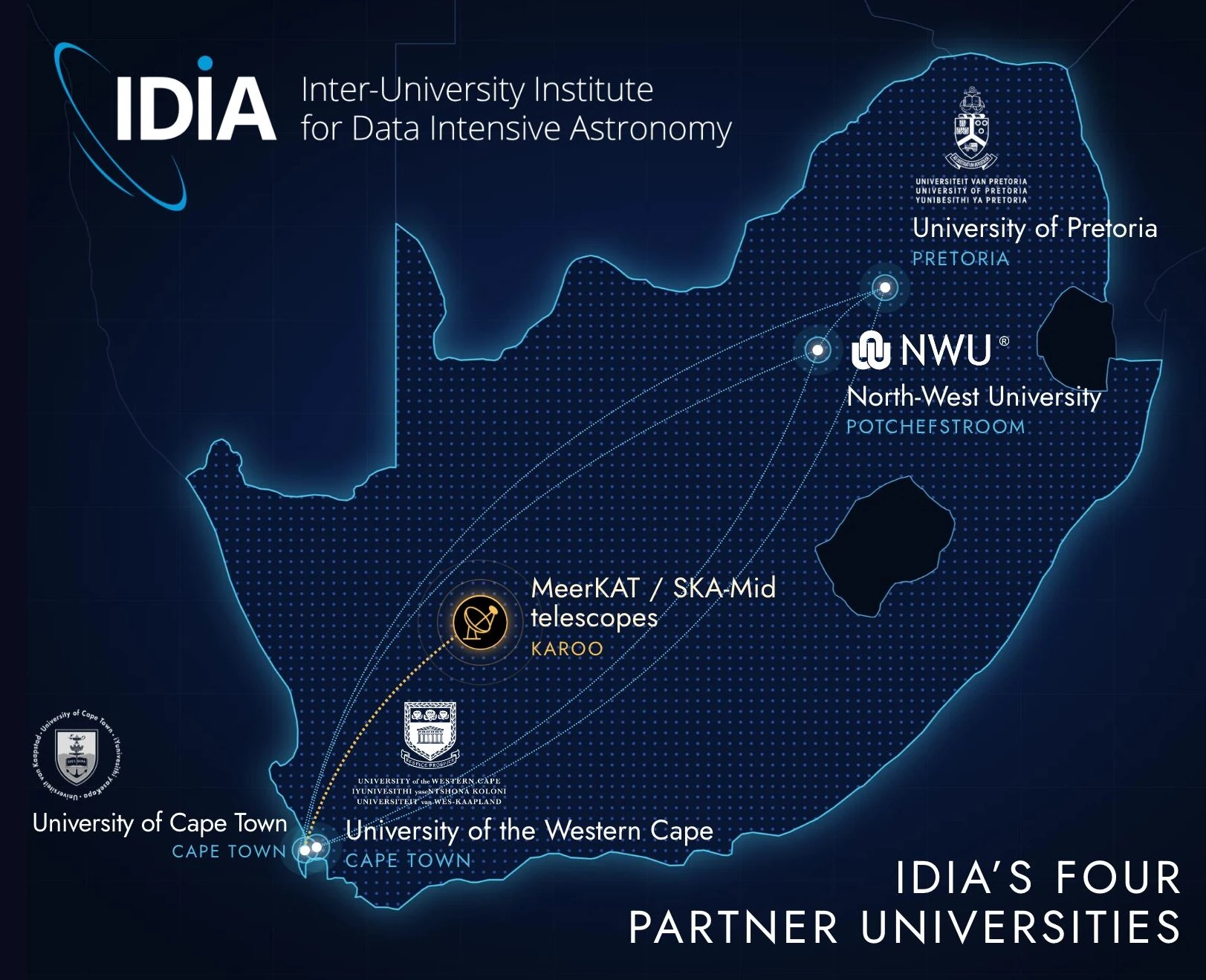
The partnership comes at an important time for South African research, as the expansion of SARAO’s MeerKAT telescope to MeerKAT+ and the future SKAO will drive increasingly ambitious scientific projects and generate growing volumes of complex data. For NWU, joining IDIA will give its researchers and students the computing, pipelines and support to maximise their scientific return from MeerKAT and MeerKAT+, and to build the skills and leadership needed for SKAO science.
“NWU is proud and excited to rejoin a partnership that has done so much to put South Africa at the forefront of data-intensive astronomy. Our return is a strategic investment in the Faculty’s research and in our postgraduate students, who will gain the skills and infrastructure to lead in the SKAO era. It also reaffirms NWU’s commitment to building scientific capacity nationally and across the continent.” – Prof Francois H van der Westhuizen, Executive Dean, Faculty of Natural and Agricultural Sciences, NWU
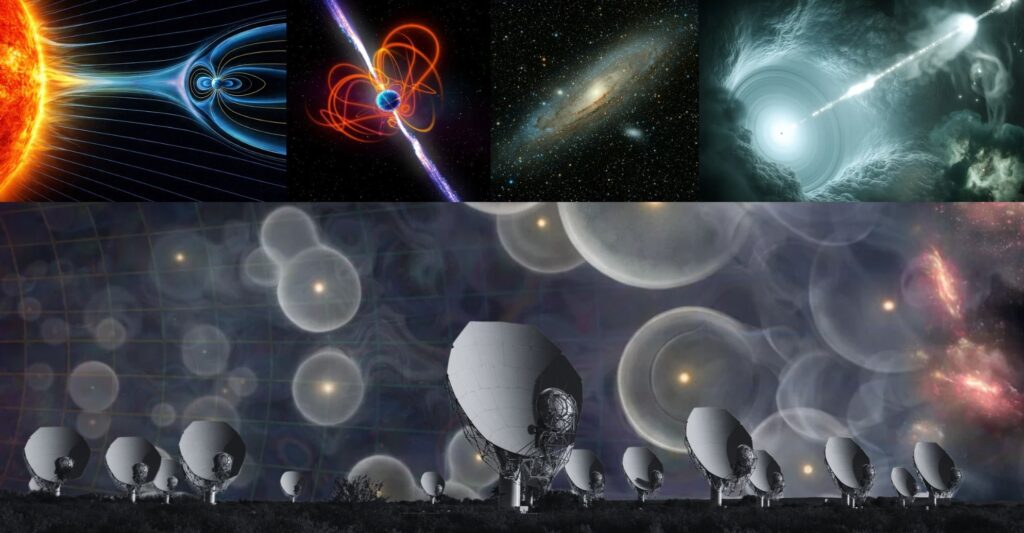
NWU’s expertise in heliospheric physics, high-energy astrophysics, cosmology and multimessenger astronomy will also create opportunities for collaboration across a wider range of research areas, notably the synergy between radio observations with MeerKAT/SKAO and gamma-ray observations with the CTAO in the study of pulsars, transients and active galaxies.
Broadening data-intensive research across astronomy and space science
NWU’s Centre for Space Research (CSR) brings together expertise spanning cosmic rays, space weather, radio, optical, X-ray and gamma-ray astronomy, neutrino physics and cosmology. The researchers are also involved in major international facilities and collaborations, including MeerKAT, the High Energy Stereoscopic System (H.E.S.S.), the CTAO and the SKAO.
This pairing of radio and gamma-ray expertise is a natural synergy: the pulsars, transients and active galaxies that the CTAO will study at the highest energies are also prime targets for MeerKAT and the SKAO.
The Centre for Space Research is home to one of the largest astronomy and space science groupings in the country. Rejoining IDIA will enable this community to go from strength to strength, and to play a leading national role as South Africa moves into the SKAO era.” – Prof Amare Abebe, NWU CSR Director
As experienced users of IDIA’s infrastructure, the CSR team have already made extensive use of ilifu for MeerKAT data analysis, including research on fast radio bursts, galaxy evolution and heliospheric physics. Through the partnership, this MeerKAT work will scale up in preparation for SKAO-era data volumes, and expand into computationally intensive modelling and simulation, as well as artificial intelligence (AI), machine learning, and large-scale optical and high-energy astronomy projects.
One example of this broader computational work is the team’s groundbreaking research into astrospheres, the vast regions formed where stellar winds interact with the surrounding interstellar medium. CSR researchers have developed three-dimensional magnetohydrodynamic (MHD) models to study the structure and evolution of astrospheres under different stellar and interstellar conditions. These simulations, which range from models of our own heliosphere to astrospheres around other stars, examine features such as termination shocks, astropauses, bow shocks and extended stellar wind tails.
The resulting plasma and magnetic field configurations provide the physical background for cosmic-ray transport calculations, allowing researchers to investigate how astrospheres modulate the cosmic-ray environments of stars and their planetary systems. The work connects stellar astrophysics, space physics and high-energy astrophysics, while also raising questions about the radiation environments of exoplanets.
“By recreating the space around distant stars on African supercomputers, we can explore how stellar winds and magnetic fields shape the cosmic-ray environments of other worlds.” – Prof Stefan Ferreira, NWU Professor and CSR Researcher