
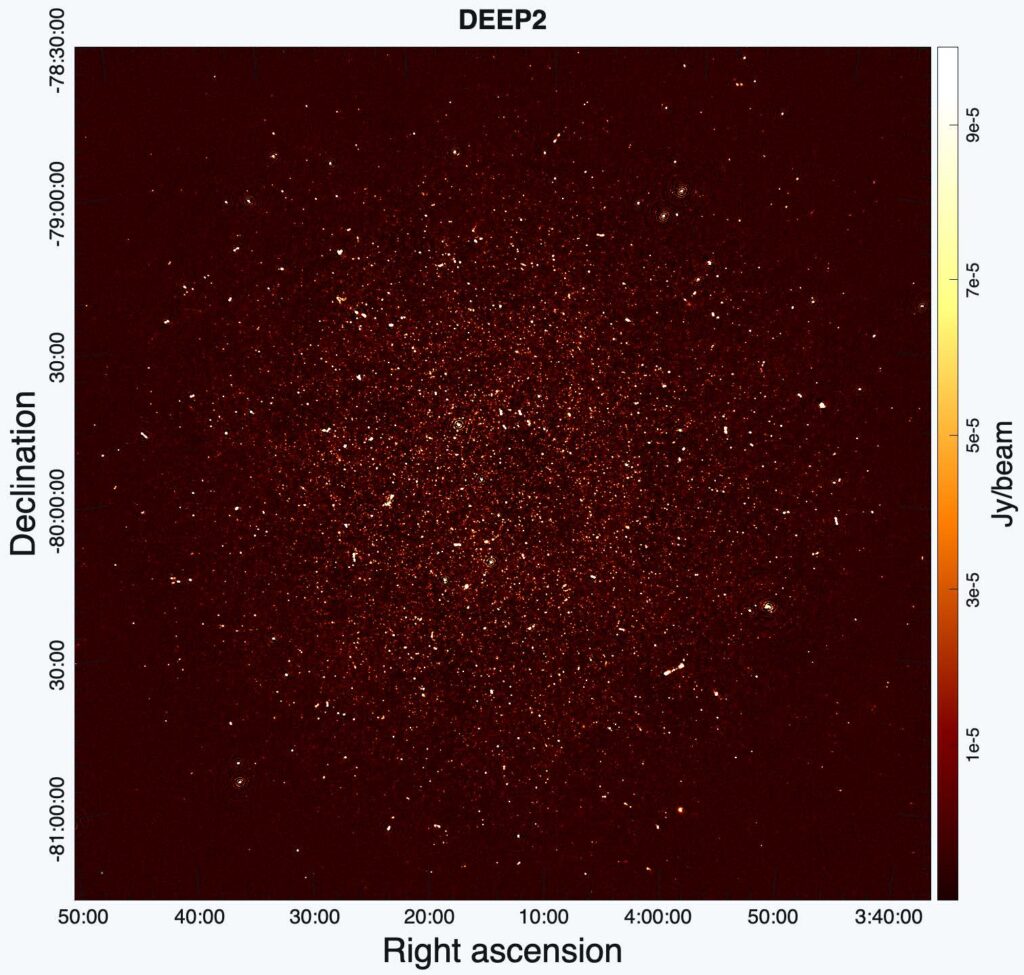
Astronomers from the University of the Western Cape and the University of Manchester have used IDIA infrastructure and South Africa’s MeerKAT radio telescope to directly detect the faint radio emission from neutral hydrogen billions of light years away. For the first time at these distances, the team made the detection using MeerKAT radio observations alone, without relying on additional optical surveys.
Published in The Astrophysical Journal Letters, the result is an important demonstration of hydrogen intensity mapping, a powerful technique for efficiently surveying vast volumes of the Universe. By tracing neutral hydrogen across cosmic distances, this approach could provide a new way to map the large scale structure of the Universe and investigate how dark matter and dark energy shape its evolution.
The analysis also made use of IDIA’s cloud infrastructure, ilifu, to process and analyse the MeerKAT data, highlighting the important role of data processing and computing infrastructure in enabling cutting edge astronomy. The study also shows how existing MeerKAT data can yield new science: the team used observations originally collected in 2018 for a different purpose, revealing their lasting scientific value.
The result points towards exciting future applications with the SKA-Mid telescope, for which MeerKAT is a precursor.
Read the full SARAO press release: SARAO press release
Read the paper in The Astrophysical Journal Letters: Paul et al. 2026